Main Street Coaching: How India's Small-Town Test-Prep Hubs Reach Rural Students That American Two-Year Colleges Struggle to Find
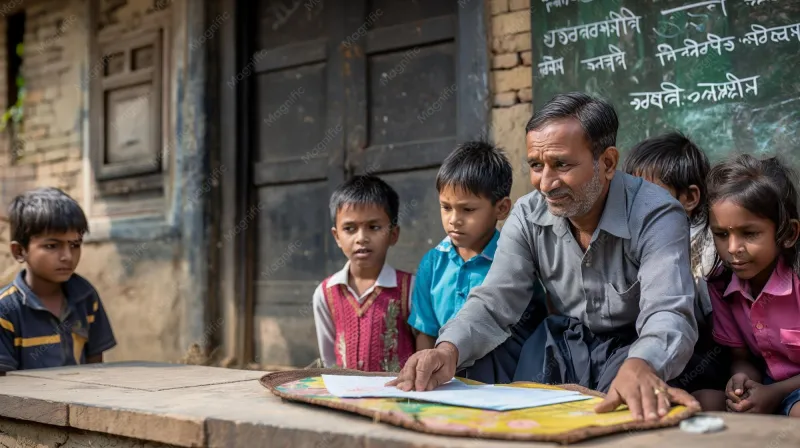
Photo: rural coaching center classroom students india small town, via img.freepik.com
A Storefront in a Small Town, a Pipeline to a Career
Drive through the secondary highways of eastern Uttar Pradesh and you will pass them without noticing: single-room establishments above provision stores, hand-painted signage advertising "CATET/BSc Agriculture Entrance — New Batch Monday," and a folding table of plastic chairs filled with seventeen-year-olds reciting soil classification from memory. These are the rural coaching centers of the Ganges belt, and they have quietly become one of the most effective rural outreach machines in global education.
For American readers, the comparison worth making is not with elite test-prep franchises in Manhattan or Palo Alto. It is with the community college — the institution the United States relies on to reach rural, first-generation, and working-class students. And by that measure, the storefront academies of Uttar Pradesh have something to teach.
What These Centers Actually Are
The typical UP CATET coaching operation in a town like Ballia, Hardoi, or Sitapur employs two or three instructors, charges the equivalent of $30 to $80 for a full season of evening classes, and draws students from a dozen surrounding villages. Many instructors are themselves recent agriculture graduates who qualified the same exam years earlier. Enrollment spreads not through advertising but through word of mouth — a cousin's success, a neighbor's recommendation, the schoolteacher who points a promising student across the street.
The curriculum is narrow and unapologetically exam-focused: physics, chemistry, mathematics or biology, and agriculture theory aligned precisely to the UP CATET syllabus. But the surrounding services matter just as much. Centers help families decode application deadlines, navigate online forms that assume reliable internet, and interpret counseling-round announcements that arrive in dense bureaucratic Hindi.
The Trust Advantage
American community colleges have spent two decades investing in outreach infrastructure: texting campaigns, CRM platforms, dual-enrollment partnerships, and glossy microsites. Yet rural enrollment continues to lag, and the students most likely to benefit from a two-year agriculture pathway — the sons and daughters of farm families — often never engage with the institution at all.
The Indian coaching model works on a different premise. It does not wait for students to find the institution; it embeds itself in the geography of daily life. The center is where the bus stops, next to the fertilizer dealer, run by someone whose family the student's family has known for a generation. In behavioral terms, the cost of the first step — walking through the door and asking a question — is nearly zero.
Community colleges cannot replicate that embeddedness wholesale, and they should not romanticize operations that vary widely in quality. But they can study the underlying mechanics.
Four Transferable Lessons for US Two-Year Colleges
1. Recruit the recently successful, not the permanently professional. Many rural Indian centers are staffed by people who passed the target exam within the last five years. Their credibility is lived, not credentialed. American colleges might similarly hire recent rural graduates — community college transfers now finishing ag degrees at land-grant universities — as part-time navigators who return to their home counties during breaks.
2. Sell a single, legible outcome. UP CATET coaching centers do one thing, and everyone in town knows what it is. Community colleges often market hundreds of programs with equal enthusiasm, diluting the message. A rural outreach effort built around one clear promise — "two years here, transfer into the ag science program there" — mirrors the legibility that makes the coaching model work.
3. Put the institution where trust already lives. The Indian center piggybacks on existing social networks: the teacher, the shopkeeper, the extended family. US colleges could formalize equivalent relationships with FFA chapters, feed-store owners, rural church congregations, and county fair boards — placing a trusted local figure, rather than a regional recruiter, at the point of first contact.
4. Treat paperwork as pedagogy. The most valuable service many Ganges-belt centers provide is not instruction but form-filling: deadlines, documents, and fee structures explained face to face. American financial aid and enrollment processes are, if anything, more labyrinthine. Rural community colleges that embed enrollment assistance into trusted community settings — the co-op office, the extension meeting hall — rather than requiring a campus visit, are acting on the same insight.
Honest Caveats
A fair accounting requires acknowledging what the coaching model does not offer. Quality control is inconsistent; some centers overpromise. The model can deepen exam-centric narrowing at the expense of broader learning. And the parallel only stretches so far: community colleges carry missions — adult education, workforce retraining, developmental coursework — that no entrance-exam academy would touch.
There is also a cautionary note. India's coaching economy has grown so large that it increasingly substitutes for, rather than supplements, formal schooling. American institutions should borrow the outreach instincts while rejecting the drift toward privatized remediation.
The Common Ground
What links a storefront academy in Uttar Pradesh to a community college in rural Iowa is a shared assignment: finding capable students in places that higher education's default machinery overlooks, and making the path from a small town to a technical career feel ordinary rather than exceptional.
The Ganges belt's coaching hubs solved that problem with proximity, trust, and a single clear promise. American two-year colleges have more resources, better technology, and stronger credentialing. What they can import is not the method itself, but the discipline of meeting rural students where they already are — and being known, locally, for exactly one thing done well.